We See It All: Liberty and Justice in the Age of Perpetual Surveillance by Jon Fasman
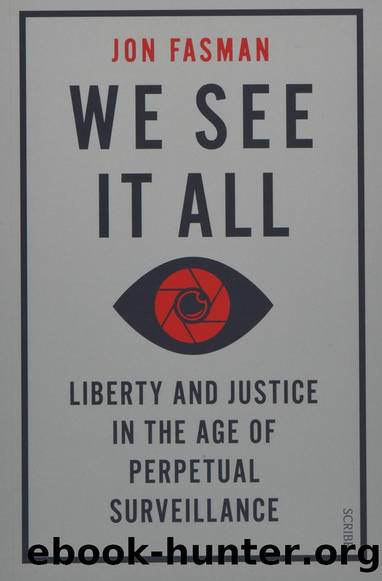
Author:Jon Fasman [Fasman, Jon]
Language: eng
Format: epub
Publisher: PublicAffairs
Published: 2021-01-26T00:00:00+00:00
Perhaps the most targeted, limited way that police use facial recognition is to generate investigative leads. The sheriffâs department in Washington County, Oregon, was the first law enforcement agency in America to use Rekognition, Amazonâs facial-recognition tool. According to both its website and a presentation by Chris Adzima, a senior information analyst with the Washington County Sheriffâs Office, at a police-tech conference in May 2019, they do not use facial recognition to surveil people going about their daily business.
The department wrote a usage policy specifically vowing that their employees would ânot employ this technology without a lawful justification that is based upon a criminal nexus,â that it would ânot employ this technology to conduct mass surveillance,â and that facial recognition could ânot be used to conduct surveillance of persons or groups based solely on their religious, political or other constitutionally protected activities.â The policy also states that âfacial recognition search results are potential leads that require follow-up investigation,â and that those results alone do not constitute probable cause.11
If a criminal suspect is caught on camera while engaged in what appears to be criminal activity, an officer, with approval from a commanding officer, compares that image to a database of county mugshot photos dating back to 2001. The picture that starts the investigation might be through any of a variety of means: through surveillance footage, for instance; or because someone took a picture of an assailant with a cellphone camera; or because a suspect consented to have his picture taken by a police officer, or has been arrested and had a mugshot taken, but refuses to provide identification. Only trained officers are allowed to run the searches.
The usage policy contains penalties for violating itâsort of (âdiscipline as appropriateâ). All requests to run searches are subject to audit, and photographs that do not turn up a match are kept for a year and then deleted from the server. As facial-recognition usage policies go, this is about as good as it gets, but itâs really not all that good. The penalties are vague, and however benevolent the aims and limited the uses, the county is still building a database that could be used for broader and less benevolent purposes later on.
At the same conference where I saw Adzimaâs presentation, I met Daniel Steeves, the chief information officer for the Ottawa Police Service. He is everything you would expect a senior Canadian police officer to be: mild, bearded, reasonable, and wry. His department piloted a program similar to Washington Countyâs: twenty-five officers in a robbery investigation unit received training and were then allowed to run images of people captured by surveillance cameras during what appeared to be criminal activityâSteeves mentioned stealing from liquor stores and gas stationsâthrough a mugshot database.
âWithout facial recognition,â Steeves explained, âyouâd have an officer sending out a broadcast email saying, âDoes anyone recognize this guy?â Youâd have two thousand people looking at an image that maybe three people should have seen.â He points out the privacy concerns surrounding that common
Download
This site does not store any files on its server. We only index and link to content provided by other sites. Please contact the content providers to delete copyright contents if any and email us, we'll remove relevant links or contents immediately.
The Secret History by Donna Tartt(19103)
The Social Justice Warrior Handbook by Lisa De Pasquale(12197)
Thirteen Reasons Why by Jay Asher(8919)
This Is How You Lose Her by Junot Diaz(6894)
Weapons of Math Destruction by Cathy O'Neil(6285)
Zero to One by Peter Thiel(5808)
Beartown by Fredrik Backman(5768)
The Myth of the Strong Leader by Archie Brown(5513)
The Fire Next Time by James Baldwin(5454)
How Democracies Die by Steven Levitsky & Daniel Ziblatt(5225)
Promise Me, Dad by Joe Biden(5157)
Stone's Rules by Roger Stone(5091)
A Higher Loyalty: Truth, Lies, and Leadership by James Comey(4967)
100 Deadly Skills by Clint Emerson(4932)
Rise and Kill First by Ronen Bergman(4797)
Secrecy World by Jake Bernstein(4756)
The David Icke Guide to the Global Conspiracy (and how to end it) by David Icke(4724)
The Farm by Tom Rob Smith(4517)
The Doomsday Machine by Daniel Ellsberg(4493)
